Every morning, a ranked list arrives in the inbox of every sporting director at every top 40 European club. Players they’ve never heard of. Leagues they’ve never watched. Probability scores next to each name, 87% chance of positive goal difference impact. 91% chance of resale value exceeding acquisition cost within three years.
Some of them ignore it. Those clubs are mostly in the second division now.
The ones who acted earliest, who understood that the market was mispricing talent on an industrial scale, built dynasties on fees their rivals considered reckless. They weren’t reckless. They were just reading different information.
It started with a baseball team that couldn’t afford to lose, a mathematician who treated players like assets, and a sport that spent twenty years insisting it was too human for numbers.
It wasn’t. None of them are.
Welcome to Part 2.
The Decision That Defines a Club
This issue is about the most consequential decision any football executive makes, who to sign, when, and how much to pay. AI is rewriting the rules of that decision. Here is how.
Every summer, football executives make bets that can define, or derail, a club for years. A failed transfer at £80 million does not just hurt the balance sheet. It occupies a position, blocks a development pathway, and sends a signal about how well the organisation thinks.
AI is changing the information environment around that decision. Not by making it easy, and not by removing human judgement, but by restructuring what you know, when you know it, and how much certainty you can attach to a price.
This issue covers the full arc, where the data revolution in sport came from, where AI is now adding genuine intelligence to the recruitment funnel, where the real competitive edge still lives, and what a rigorous AI-informed transfer process actually looks like. It ends with a practical framework you can apply before your next significant bid.
What part 1 covered
Part 1 established the conceptual architecture behind modern AI in football: the distinction between Weak and Strong AI, and the two dominant paradigms shaping today’s systems, Symbolic AI and Neural Networks, and why these approaches are fundamentally different. If you haven’t read it, give it a read as it only helps your understanding of what we are going to discuss below.
The Long Arc of the Data Revolution
The story begins in a baseball dugout in Oakland, California, in 2002.
Billy Beane, General Manager of the Oakland Athletics, had one of the lowest payrolls in Major League Baseball. Rather than accept this as a permanent disadvantage, Beane and statistician Paul DePodesta turned to sabermetrics, the rigorous statistical analysis of baseball, to identify what the market was systematically mispricing.
Their insight was deceptively simple. Traditional scouts valued batting average, stolen bases, and physical appearance. The data showed that on-base percentage (OBP) and slugging percentage were far more predictive of run production, and therefore wins, than any of the metrics scouts obsessed over. Players with high OBP but low batting averages were being systematically undervalued. Beane bought them cheaply. The 2002 Athletics won 103 games on a $44 million payroll, matching the New York Yankees who spent $125 million.
The Moneyball Principle
The lesson is not 'use data.' The lesson is: find the inefficiency the market has not yet priced in, and exploit it before everyone else does. This is precisely what AI enables in football recruitment today.
The NBA’s Moneyball: A Second Wave
A decade later, Daryl Morey applied the same logic to basketball. Expected value mathematics showed that mid-range jump shots, one of the most common plays in the NBA, returned fewer points per possession than any alternative. Morey built his Houston Rockets rosters around three-point shooting and drives to the rim: the two highest-value shot types. His rivals thought he was wrong. His results proved otherwise.
Why Football Is Different
Football resisted the data revolution longer than any major sport, for structural reasons. Baseball is discrete and turn-based, every play separable, every outcome countable. Football is continuous, with 22 players in constant motion, creating interactions that are genuinely complex to measure.
That barrier has now collapsed. Computer vision systems track every player’s position 25 times per second. Event data companies now cover leagues from the Faroe Islands to the J-League. Wearable sensors measure physiological load during training. The data exists. The question is who knows how to use it.
The Current Opportunity
Football is now where baseball was in 2002, a market with enormous, exploitable inefficiencies. A small number of clubs understand this. The majority still rely on the same scouting instincts that cost Premier League clubs an estimated £1.1 billion in failed transfers since 2021.
Subscrever
The Four AI Types You Need to Understand
Before evaluating any vendor proposal, get these straight. They are not interchangeable, and conflating them will lead you to either overpay or underbuy.
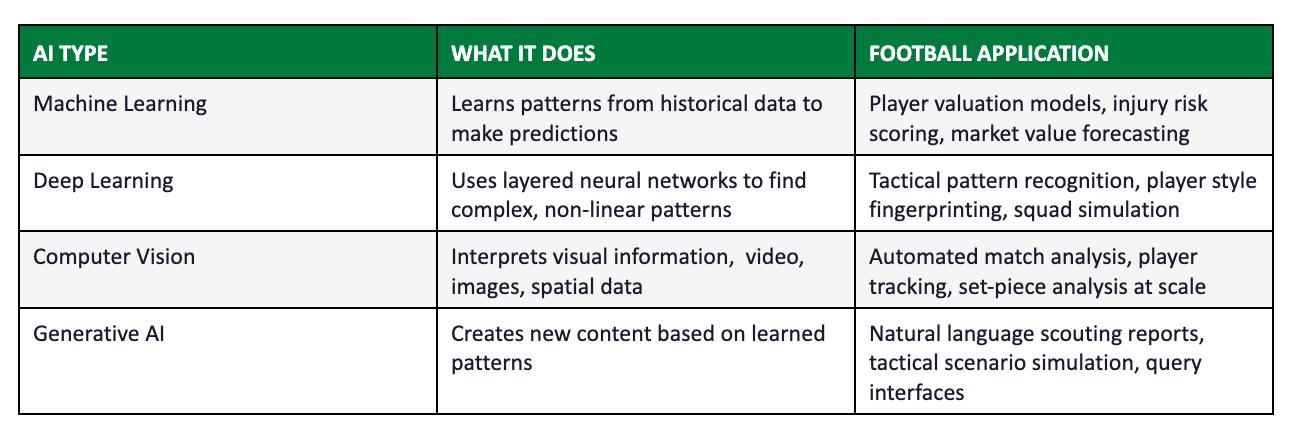
The Three Levels of Analytics and Where the Advantage Lies
Most clubs currently use descriptive analytics, dashboards that tell you what happened. The competitive advantage lies in predictive analytics (what will happen) and prescriptive AI (what you should do about it). The gap between these three levels is where the market inefficiency currently lives. Fewer than 30 clubs globally have reached the prescriptive level.
The £1.1 Billion Problem
Since 2021, Premier League clubs have collectively wasted an estimated £1.1 billion on failed transfers, players who significantly underperformed their fee, suffered career-ending injuries shortly after signing, or were sold at a fraction of their purchase price within two seasons.
Three examples illuminate what inadequate information processing looks like at the moment of decision.
Three Transfers That Should Have Been Preventable
1.Jack Grealish - Manchester City, £100 million (2021). Grealish arrived as the most expensive British player in history. He scored 13 Premier League goals across four seasons before departing on loan to Everton in 2025. His technical quality was never in question. The problem was fit: his free-roaming style suited a dominant, possessing team less well than the data available at the time of signing should have suggested.
2. Philippe Coutinho - Barcelona, €160 million (2018). Barcelona’s record signing was immediately loaned to Bayern Munich after a difficult first season, and eventually sold to Aston Villa for €17 million, a write-off of over €140 million. The failure was partly tactical, partly psychological, and partly a function of the pressure that comes with being the most expensive player in a club’s history. None of these risk factors were adequately modelled. The club paid for a name, not a probability distribution.
3. Paul Pogba - Manchester United, £89 million (2016). Pogba’s second spell at United was characterised by inconsistency, injury, and an acrimonious departure. The transfer exemplified what data scientists call the ‘star player fallacy’, the assumption that individual brilliance translates directly to team improvement, regardless of system fit. It does not. The data has been saying this for years.
The Core Problem
These are not stories of bad luck. They are stories of decisions made without sufficient information, specifically, without integration modelling. AI does not eliminate transfer risk. It restructures the decision so you understand the risk before you sign, not after.
Three Stages of AI-Augmented Recruitment
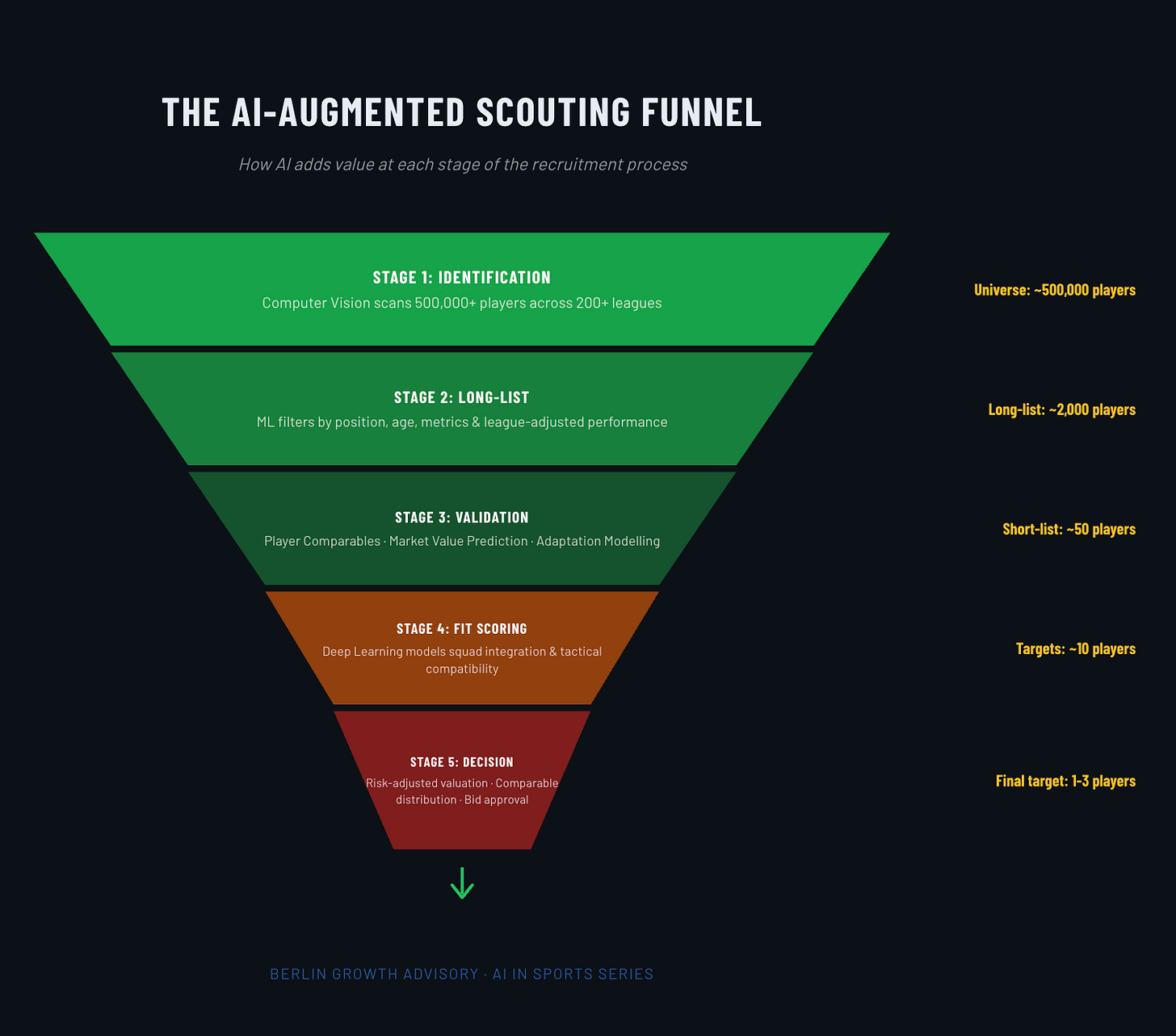
Stage 1: Identification (The Search Problem)
The global football ecosystem contains approximately 500,000 professional and semi-professional players across more than 200 leagues. Elite talent identification still happens, overwhelmingly, through a network of human scouts with geographic and cognitive biases. They watch who they know. They prioritise the leagues their clubs already have relationships with. They notice what is conspicuous.
Computer vision systems have fundamentally changed this. Platforms like StatsBomb, Wyscout, and PLAIER ingest video from lower-league matches, the Eredivisie, the Belgian Pro League, the Brazilian Série B, and generate statistical profiles that surface in ranked outputs.
The practical power of this is significant. A sporting director can now instruct their data team: ‘Find me every left-footed centre-back in the top four tiers of European football who completes more than 80% of progressive passes under pressure and is under 23.’ That query, impossible to execute manually, returns in minutes.
Stage 2: Validation (The Prediction Problem)
Once a player is identified, the challenge shifts, will they perform at the required level in a new environment? This is where machine learning models earn their value.
- Player comparables. By analysing historical performance trajectories of players with similar statistical profiles, age curves, and positional characteristics, ML models generate probability distributions for future performance, not a single prediction, but a range of outcomes with associated likelihoods.
- Market value forecasting. AI-driven market value predictions are now demonstrably more accurate than crowd-sourced estimates. For a club buying a player whose fee the market is mispricing, in either direction, this is material.
- Adaptation modelling. The most sophisticated capability available is the modelling of cross-league adaptation. How much does a player’s output typically decline when moving from the Eredivisie to the Premier League? From the Austrian Bundesliga to the Championship? AI models trained on thousands of historical transfers can now quantify this with genuine statistical rigour.
Stage 3: Integration (The Fit Problem)
The third stage, and the one most clubs currently underinvest in, is integration modelling, predicting not just whether a player is good, but whether they will make a specific team better.
The Harry Kane example is instructive. When Kane signed for Bayern Munich in 2023, PLAIER’s models predicted he would not have a positive impact on the team’s goal difference. The prediction proved accurate: Bayern scored fewer goals in Kane’s first season than the previous one, despite adding one of the most prolific strikers alive. Kane was not the problem. The tactical mismatch was.
The same logic applied to Erling Haaland’s first season at Manchester City. City scored fewer goals than in the prior campaign despite adding a generational finisher. AI models explained this before it happened: Haaland’s style of play conflicted with City’s possession-and-movement system in ways that took a full season to resolve.
The Uncomfortable Implication
Integration modelling sometimes tells you not to sign a player you love. A player who would be brilliant at 90% of clubs may actively make your team worse. That is the finding most clubs are not yet equipped ,culturally or analytically, to act on.
A Quick Summary
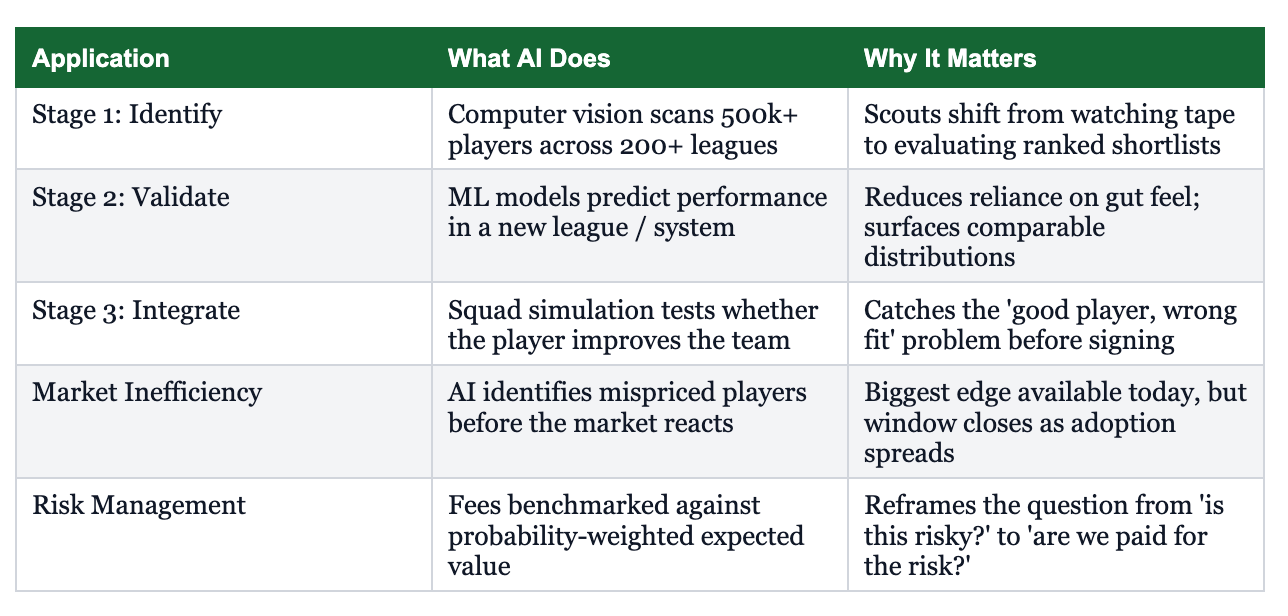
Finding Market Inefficiencies Before the Market Does
The most sophisticated application of AI in recruitment is not improving the evaluation of players everyone already knows about. Any club can run regression on a Bundesliga midfielder with 40 career appearances. The edge is elsewhere, finding players the market has systematically mispriced, in leagues it is not watching, before the arbitrage disappears.
In financial markets, this excess return generated by exploiting an unrecognised inefficiency is called alpha. In football, the equivalent is signing a player for €5 million who is worth €50 million. This happens because you were looking where others were not.
The Brighton Model (Systematic Alpha Generation)
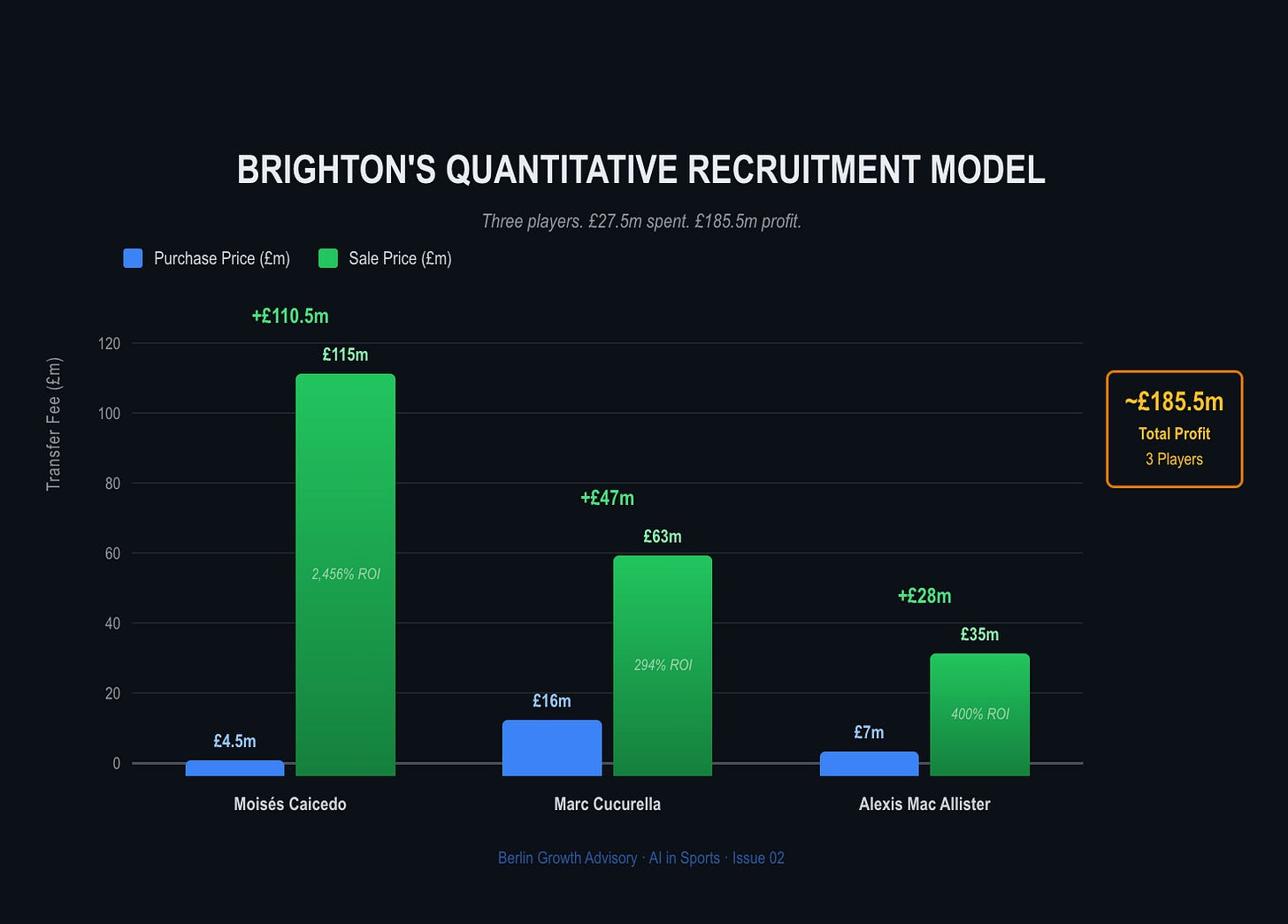
Brighton’s transformation from a club that narrowly escaped Championship relegation in 2009 to a consistent top-half Premier League club and Europa League qualifier is the most instructive case study available. It was not driven by ownership wealth. It was driven by an owner, Tony Bloom, a professional gambler and data analyst, who understood information advantage.
Moisés Caicedo is the paradigmatic example. Brighton signed him from Independiente del Valle in Ecuador, a league that virtually no European scouts monitored systematically. Their data system flagged his pressing metrics, passing range, and defensive positioning as elite outliers relative to his age. Chelsea eventually paid £115 million for a player Brighton acquired for under £5 million.
The same pattern produced Alexis Mac Allister (sold to Liverpool, £35 million), Yves Bissouma (sold to Tottenham, £25 million), and Marc Cucurella (sold to Chelsea, £62.5 million). This is not luck. It is a repeatable process.
The Brighton Insight
Brighton was not smarter than Chelsea or Manchester City about Caicedo once everyone could see him. They were smarter earlier, in a market where information asymmetry still existed. That window closes. But for clubs willing to build the infrastructure, new ones keep opening, in different leagues, different positions, different age groups.
Four Systematic Inefficiencies AI Can Exploit
- League discount. Players in smaller leagues are systematically undervalued relative to their performance metrics, even after adjusting for league quality. The market applies a visibility penalty that is not justified by the underlying data.
- Age curve mispricing. The market overpays for players in their mid-to-late 20s, peak visibility, peak reputation, and underpays for players aged 19–22 on steep development curves. AI models trained on career trajectory data can identify when an emerging player’s current market price significantly understates their likely peak value.
- Positional neglect. Defensive midfielders, left-backs, and central defenders are systematically less visible than attacking players. Exceptional performers in these roles frequently trade at a discount to their actual contribution to team performance ,a discount that shows up clearly in AI output and rarely in traditional scouting reports.
- System dependency. Players who perform exceptionally within an unusual or obscure tactical system are frequently undervalued when their aggregate metrics look mediocre. AI can decompose performance into system-dependent and system-independent components, identifying players whose true quality is hidden by context.
AI Recruitment Is Quantitative Finance Applied to Human Capital
The most powerful conceptual frame for understanding what is happening in football recruitment is not sport at all. It is quantitative finance.
In the 1980s and 1990s, a new class of investment firms, quant funds, began replacing analyst intuition with systematic models. Where traditional investors used judgment and relationship-driven insight, quant funds used algorithms to identify price discrepancies, build probabilistic distributions of outcomes, and size positions according to expected value rather than conviction.
The football parallels are precise. Traditional scouts operate like fundamental analysts, they watch the player, form a view, and advocate for or against a signing based on qualitative judgement. AI-augmented recruitment operates like a quant fund, i.e it builds a probability distribution of outcomes, prices each outcome, adjusts for league quality and positional context, and recommends a maximum fee consistent with positive expected value.
The analogy extends further. Quant funds discovered that the most persistent alpha came from markets with the least information, small-cap stocks, emerging market bonds, illiquid instruments that institutional money ignored. Football’s equivalent is the Ecuadorian Primera Categoría, the Danish Superliga, the South African Premier Division. The clubs building systematic data coverage of these leagues are operating exactly like quant funds moving into frontier markets before the institutions arrive.
The Risk Management Dimension
Quantitative finance also provides the right framework for thinking about transfer risk. In finance, risk is not something to be eliminated, it is something to be priced and managed. A quant fund does not avoid volatile assets. It ensures the return profile is adequate given the volatility.
The same logic applies to transfers. The question is never ‘is this transfer risky?’ All transfers carry risk. The question is, are we being adequately compensated for the risk we are taking? A £60 million fee for a 24-year-old with a strong injury history and a short contract runway may be a poor risk. A £60 million fee for a 21-year-old with three years of elite-level data, a long contract, and a resale value that has a reasonable probability of exceeding the fee represents a very different risk profile. AI makes the distinction legible.