How can we evaluate Shot Stopping?🧤
Last week, Remko Pasveer announced his return to Heracles Almelo. Trying to save his former club from relegation might be his final challenge before potentially retiring after this season.
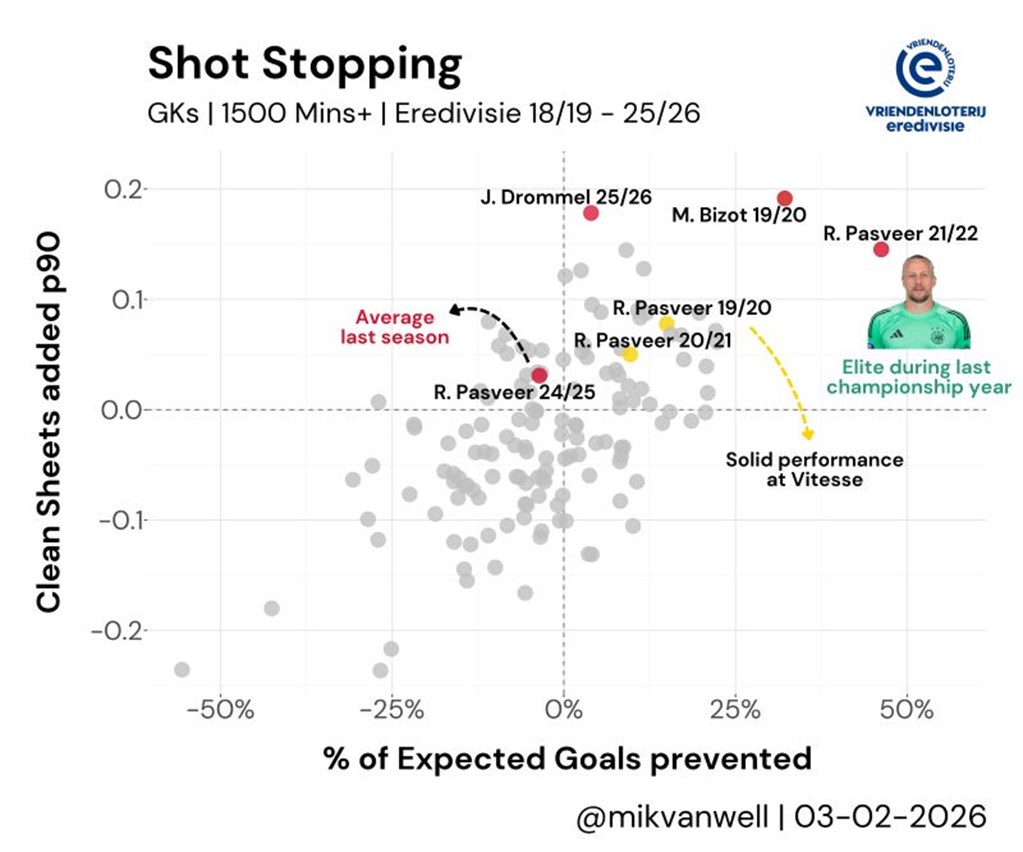
Coincidentally, a few days later I came across his incredible 21/22 season at Ajax while working on my player evaluation research. The aim of this project is simple: turning raw Wyscout data into clear, interpretable football attributes.
When it comes to goalkeepers, the most sophisticated way to evaluate shot stopping is by comparing goals conceded to 𝗽𝗼𝘀𝘁-𝘀𝗵𝗼𝘁 𝘅𝗚 (PSxG). Converting this into a percentage of PSxG prevented shows that Pasveer’s 21/22 season was 𝘣𝘺 𝘧𝘢𝘳 the best shot-stopping performance of any Eredivisie goalkeeper since 18/19.
His 𝗚𝗼𝗮𝗹 𝗣𝗿𝗲𝘃𝗲𝗻𝘁𝗶𝗼𝗻 % was at least twice as high as every other goalkeeper's, except for Marco Bizot in 19/20. During that season, Bizot’s market value increased by over 50%. The former AZ keeper is now the back-up to a former Golden Glove winner at Aston Villa. That year, Bizot also led the second metric on my scatter plot: 𝗖𝗹𝗲𝗮𝗻 𝗦𝗵𝗲𝗲𝘁𝘀 𝗔𝗱𝗱𝗲𝗱.
Not every goal is worth the same. A crucial 90th-minute save to preserve a clean sheet can be worth up to 2 points; the difference between relegation and survival, or silverware and disappointment.
Using a Poisson Distribution, I estimated how many additional clean sheets goalkeepers kept 𝘢𝘣𝘰𝘷𝘦 or 𝘣𝘦𝘭𝘰𝘸 expectations, per 90 minutes.
The only other goalkeeper outperforming Pasveer in this metric is 𝗝𝗼𝗲𝗹 𝗗𝗿𝗼𝗺𝗺𝗲𝗹 this season. With a market value of just €2.0M, a move for the 29-year-old might be worth a shot.