Since promotion to the Premier League, by winning the 2013 Championship play-off final, Crystal Palace have established themselves as a financially secure and professionally managed football club.
They have scouted promising players from the lower leagues, developed them, and sold them on, and not from a position of distress, but rather strength. As such, they have regularly secured high fees for their players.
In the Premier League, they have often secured their ‘traditional’ mid-table finish (between 10th and 15th), although they have occasionally flirted with European qualification via their league placing.
The fact is, though, that they had not enjoyed any major trophy wins in the 120 years since they were founded until they made club history by beating reigning league champions Manchester City in the 2025 FA Cup Final.
That also saw them qualify for Europe (the UEFA Europa League, to be exact). They did this after selling one of their best attackers, Michael Olise, the previous summer. The winger joined Bayern Munich and Palace pocketed a profit of £50m on a player they bought from Reading less than three years earlier.
Palace fans were in heaven, but within a month, Nottingham Forest were asking for clarity around whether Palace should be allowed to play in the Europa League after concerns over their ownership.
Two months later, in early August, the Court of Arbitration for Sport (CAS) confirmed that Palace had failed to comply with the regulations (which they had to do on or before March 1st 2025) when it came to providing assurance around the influence of minority shareholder John Textor, who was also the majority shareholder of French club Lyon.
Alongside Forest, Lyon would go on to play in the Europa League, with Palace being demoted to the less financially lucrative Conference League.

Credit: Instagram - @cpfc
Palace Chairman Steve Parish described the CAS verdict as “probably one of the greatest injustices that has ever happened in European football” – a statement that seemed to lack self-awareness, considering other clubs (including Forest) had taken the necessary action and given UEFA the required assurances over multi-club ownership.
While many thought the decision was harsh, few had sympathy with Palace, and although not strictly true, Parish and his club were ridiculed by opposition fans for “failing to fill a form in on time”, and costing the club in the region of £20million, if some reports are to be believed.
A few days after the CAS decision, Palace fans were again at Wembley, and this time they beat Liverpool, the new reigning Premier League champions, to allow proud captain Marc Guehi to lift the Community Shield.
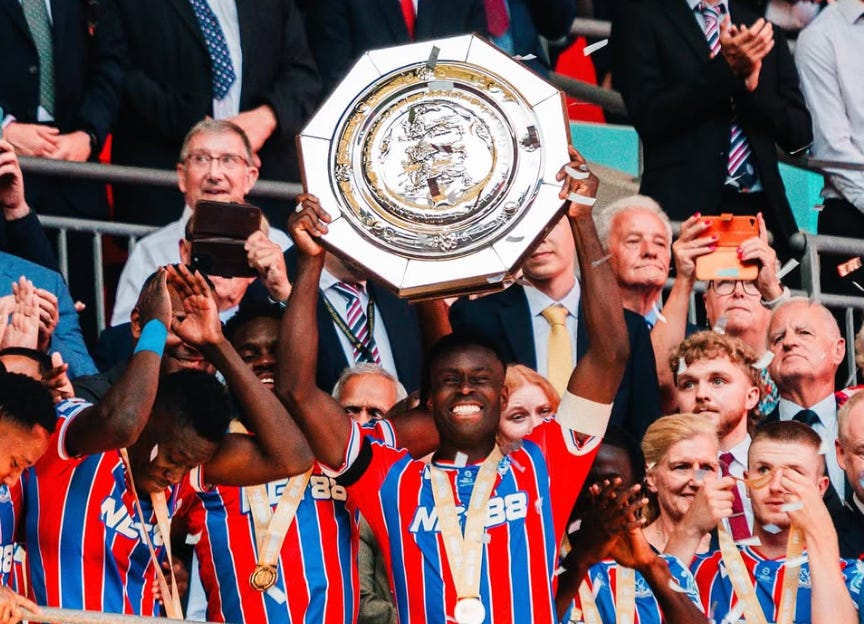
Credit: Instagram - @marcguehi
All, then, seemed well, and Palace started the season undefeated in August despite boss Oliver Glasner wanting more recruits.
But the mood music changed when, having sold Eberechi Eze to Arsenal for up to £67.5m the week before, and with less than four hours to go before the close of the summer transfer window, Palace agreed to sell their skipper to Liverpool for £35m.
Glasner insisted Guehi could not leave without a proper replacement, and rumours persist that he even threatened to resign should Palace go ahead with the sale.
Eventually, the deal collapsed, and Guehi stayed at Selhurst Park, but the fracture in the relationship between the Board and the manager was not going to heal easily. Public statements were made, but behind the scenes, things were not as rosy, and with Glasner out of contract at the end of the season, optimism started slipping away, as did Palace’s league position, both in the Premier League and in the Conference League, which they had started as favourites to win.
Palace saw a 19-game unbeaten streak come to an end in dramatic fashion against Everton in early October, and they have not been able to recover that form as they have contended with the extra strain brought on by a European campaign. Their failure to progress automatically into the knockouts of the Conference League should not be overlooked, either.
Then, on January 16th, less than a week after his team had been on the end of the biggest FA Cup upset in the history of the competition, Glasner announced he would be leaving at the end of the season when his contract expired; he criticised the club’s transfer policy and specifically their decision to sell club Guehi, adding that he felt “abandoned” by senior members of the club. To many, this signalled the imminent sale of Guehi and, sure enough, he signed for Manchester City three days later for a reduced fee of £20m. It was as clear as day that the fracture in the internal relationships was now a chasm, and an irreparable one at that.