📚 Contents
- Mats Wieffer and core strength
- Agility, spacial awareness, running power, ft. Carlos Baleba:
- Georginio Rutter + Matt O’Riley: no cohesion?
- Yasin Ayari
- Lewis Dunk and a shift at LB
- Wide progression
- Deep progression
- Penalties and the bee’s knees
- Pressing post-subs (yikes)
- Diego Gómez
- Rodrigo Muniz
Note for email readers: This email is truncated. To read the full article, please click on this link or the link to the right of [Message clipped] note at the bottom of this email.
Share
Mats Wieffer and core strength
I’ve spoken a lot about why I think Mats Wieffer will benefit from playing as the right back, and it essentially boils down to one main reason: he won’t be shunted into midfield, having to cover (and be responsible for) tackling the entirety of the pitch.
And for someone who I’d deem to be quite rash in challenges, eliminating 50% of the pitch and giving him less room for error sort of creates an environment in which Wieffer can “outgrow” the questionable tackles while still getting actual on-field practice.
Take this, for example:
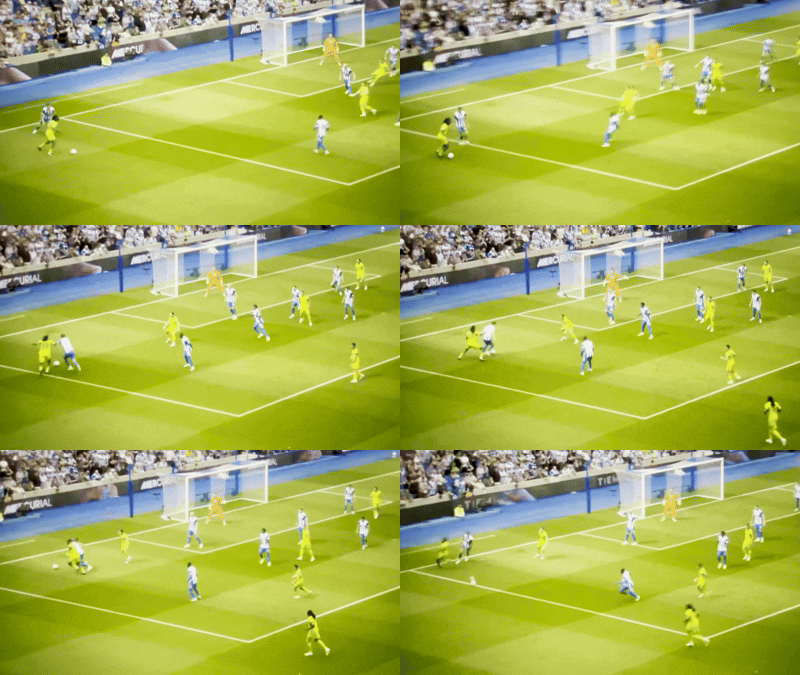
Wieffer overshoots his marker (twice), but manages to get himself in front of him anyway. From there, he leverages a stiff arm to create distance and push the defender back, while bending over for a more stable centre of gravity + stronger (compressed) core.
He wins the ball back without ever having to make a tackle — and considering he’s in the penalty area (and is, again, rash in challenges), that’s invaluable.
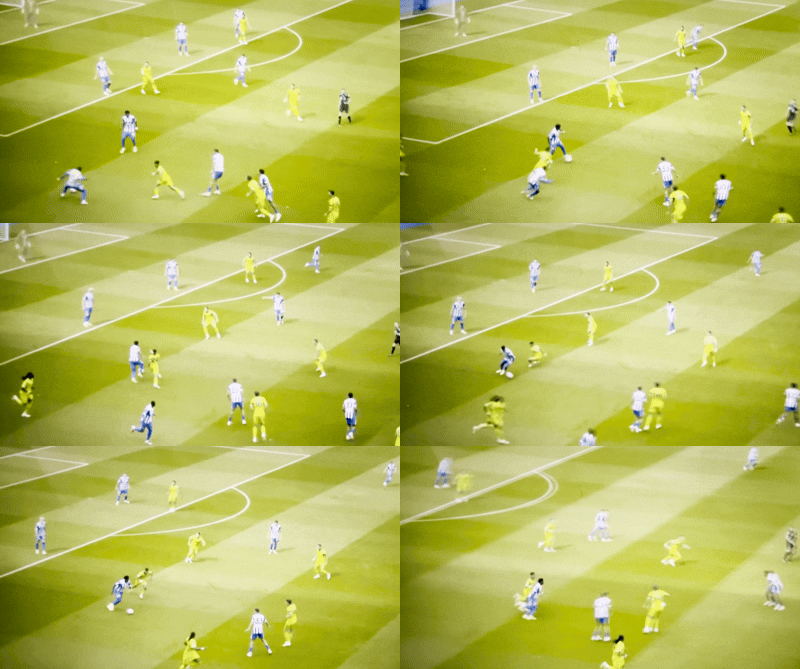
Agility, spacial awareness, running power, ft. Carlos Baleba:
Georginio Rutter + Matt O’Riley: no cohesion?
An issue we saw with Brighton last season was that two similar players were used in zones close to each other, meaning they both tried to do the same thing and ended up stepping on each other’s toes. I think we saw the same vs. Fulham with Georginio Rutter and Matt O’Riley.
Georginio Rutter’s best work comes from advancing into this area (where he makes a pass from below):
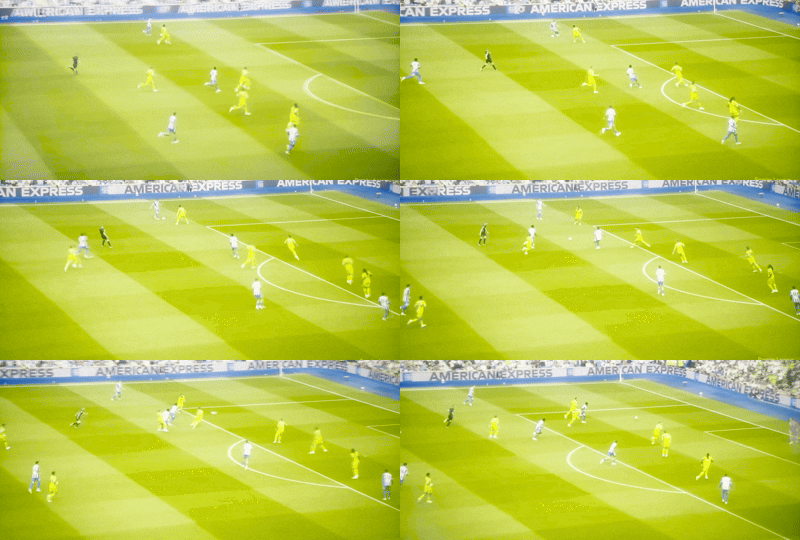
Lurk around the edge of the box, get a few touches on the ball, *ball magically moves further into the box* and Georginio Rutter gets into a shooting spot near the penalty area where he can make things happen.
In other words, Georginio Rutter is currently an attacking midfielder *gasps in non-existent surprise*
But Georginio Rutter played as the CF vs. Fulham. Sure, Matt O’Riley often found himself as an 8 in a 4-3-3 (he dropped plenty deep), but when he did advance, he either went very central or too wide — and there were no passing lanes available to Georginio.
Now, this isn’t O’Riley’s fault, simply because a) Fulham were compact, and b) Brighton preferred progressing the ball out wide, but having a player who likes to drop deep (even from CF) manage 0 completed passes across 45 minutes isn’t really ideal.
This approach could work for Tzimas, because he’ll impose himself onto the game, but I think Georginio would do far better if he started deep and advanced accordingly.
I also think there was some confusion while pressing, specifically while pressing after… throw-ins?
When Fulham got a throw-in deep(ish) in their own half, Georginio and O'Riley would go m2m (as you do) to cut off passing options, which makes sense. But after Fulham regained possession and Georginio + O'Riley scrambled back to their pressing zones (LF and RF in a 4-4-2), they often stepped into each other’s zones and were left in general confusion wrt what to do.
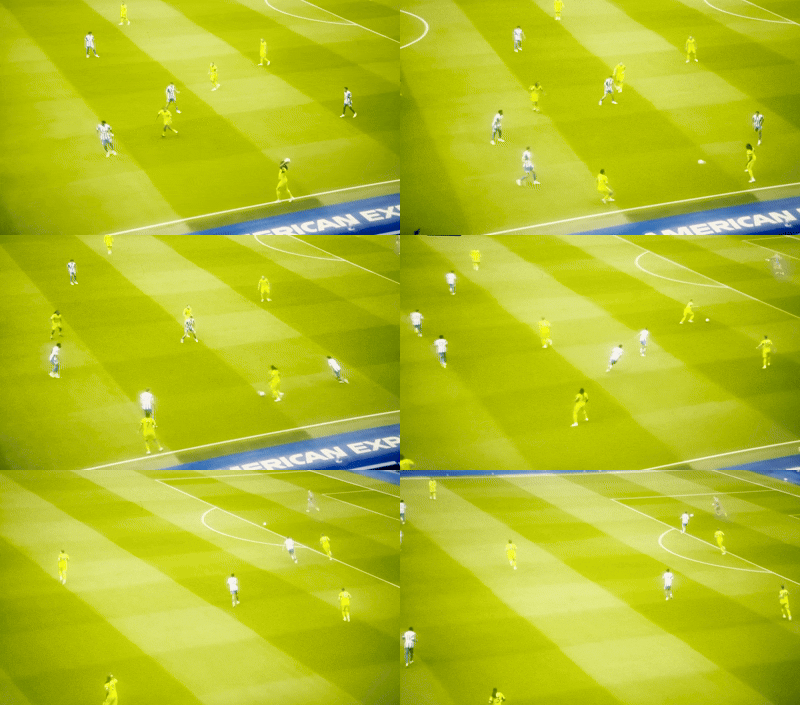
This meant they’d end up one behind the other, marking the same space and leaving a huuuuge gap for Fulham to play through, especially with Ayari being used as the pressing trigger behind.
I think using Ayari as the pressing trigger (situationally) instead of Baleba was smart, but the throw-in confusion is definitely an area for marginal gains, imo.
Yasin Ayari
Speaking of which, I think Ayari had a really good game yesterday. In this one sequence (below) where de Cuyper was VERY high and wide, and Dunk acted as the nominal LB to take up that space. Ayari immediately dropped into ~LCB zones to help progress play, and once Brighton established a secure Dunk + van Hecke base, Ayari pushed up just a bit to create an [easier] passing option given the press they were facing.
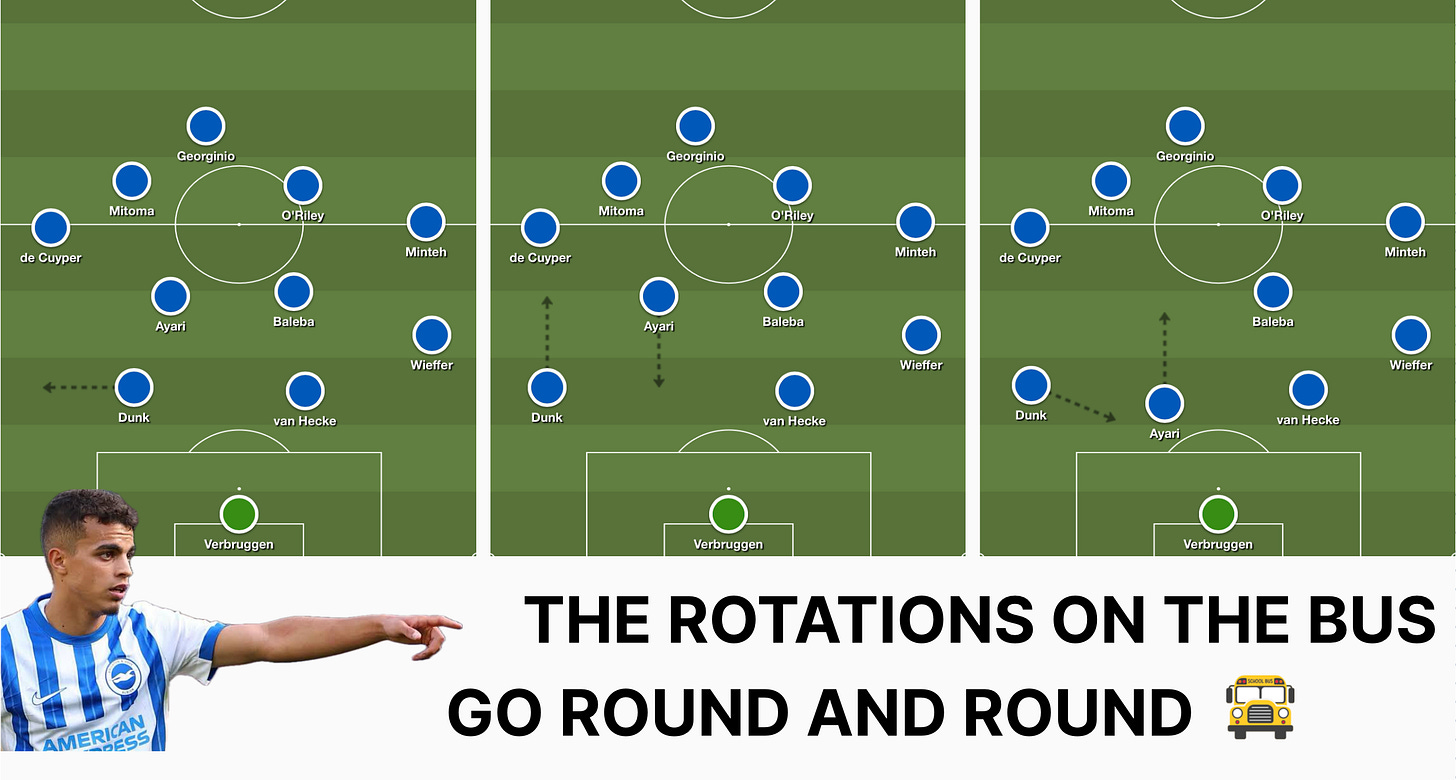
He was more than happy to call for + collect the ball in dangerous zones, and considering the volume of passes he received, it’s clear his teammates trust him with the ball.He ran and ran and ran and whatdoyoumean he covered the third most distance out of all Premier League players in Gameweek 1?
Lewis Dunk and a shift at LB
I found Dunk’s positioning, both in and out of possession, quite interesting:
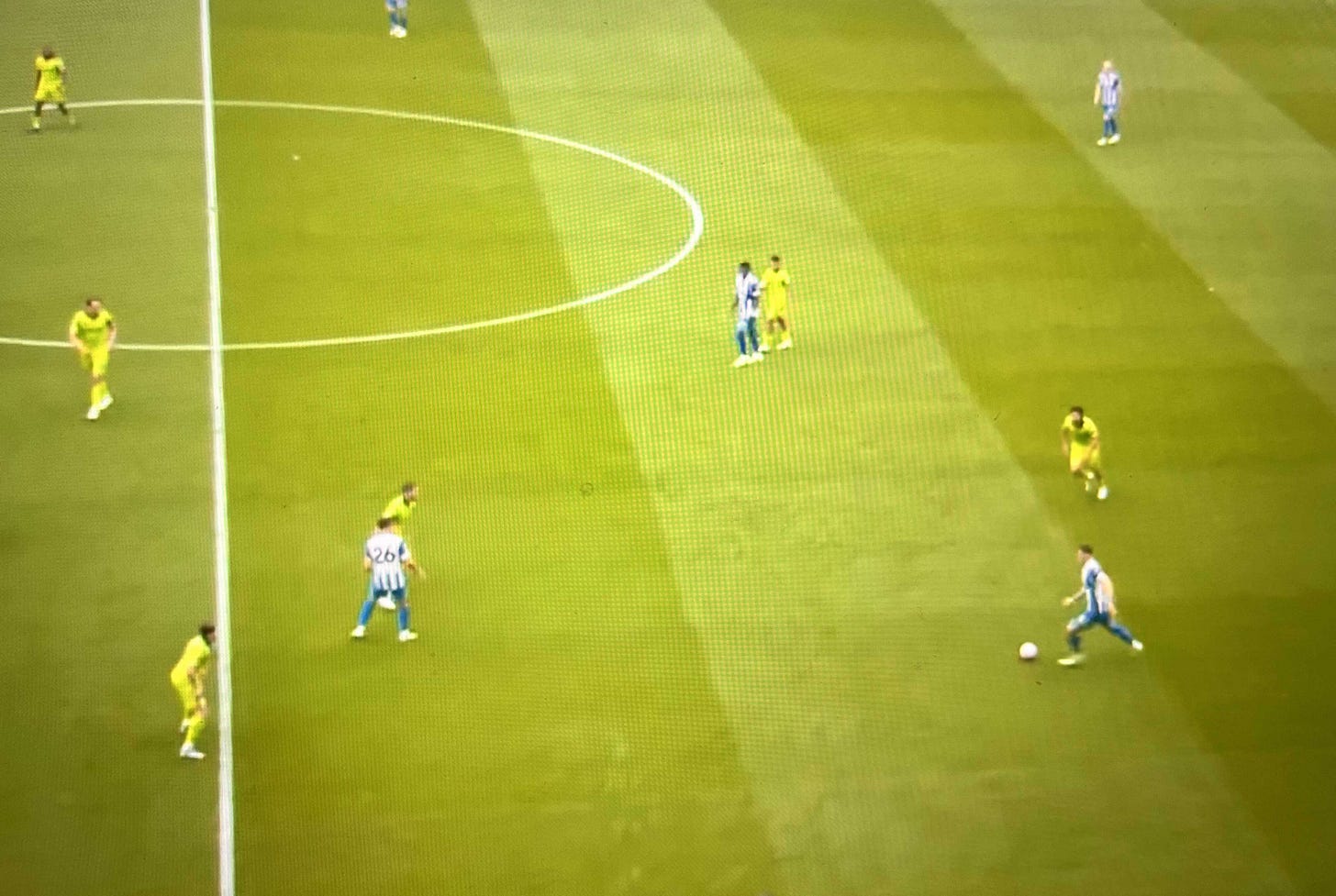
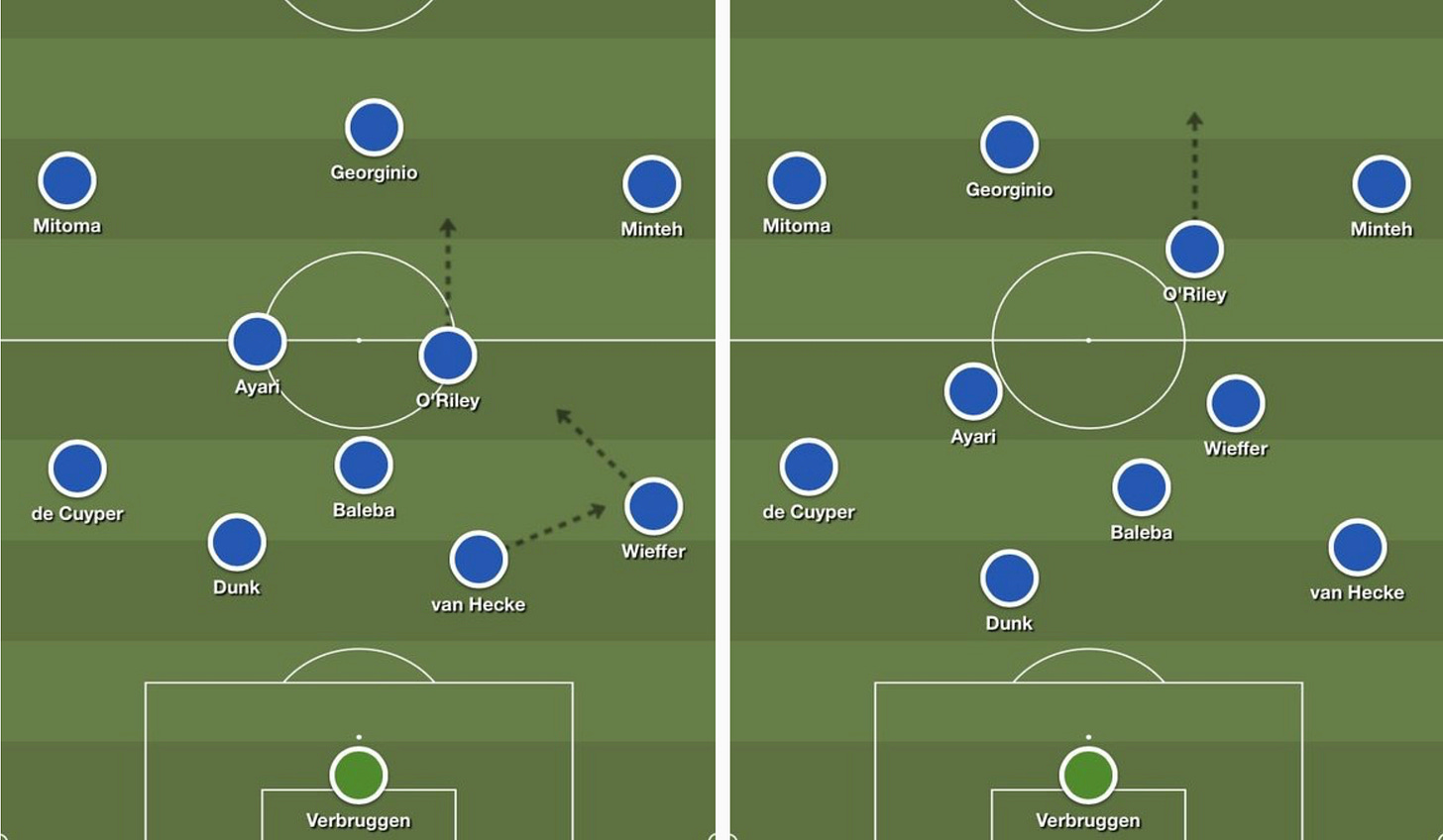
With Wieffer (RB) settling into midfield (image) or de Cuyper staying high + wide, van Hecke and/or Dunk had to periodically play as FBs. Both have the skillset to do so, and Boscagli + Igor should manage too. I think this does have a couple of issues: a) Dunk’s athleticism (but Baleba covers), and b) Coppola will need some time to settle in, given his previous experience coming as the CCB in a back three, but is otherwise great (and fluid).
Dunk was also used as an aggressive m2m option out-of-possession:
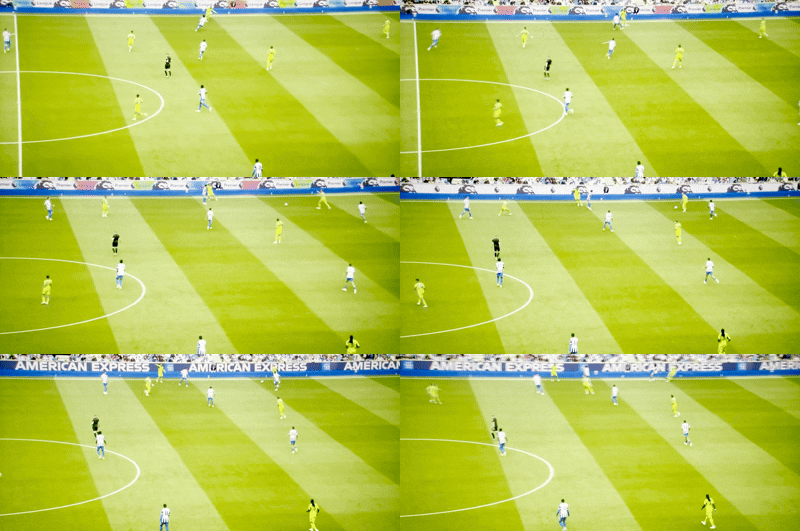
In theory, this is *fine* because you still have a few options sitting back, but Dunk doesn’t have the legs to get back, so you’re really relying on his 3rd percentile tackles to win you the ball back.
The issue is when de Cuyper lunges for the ball and Dunk aggressively parks himself next to him, before both miss the ball and the opposing RW has some fun:
Then you’re sorta left with a rest defence of
— Baleba —
— van Hecke — Wieffer —
One player who can cover ground quickly (but is high up the pitch), and two who… can’t. Erm.
Wide progression
I think a lot of Brighton’s play is built around switches of play.
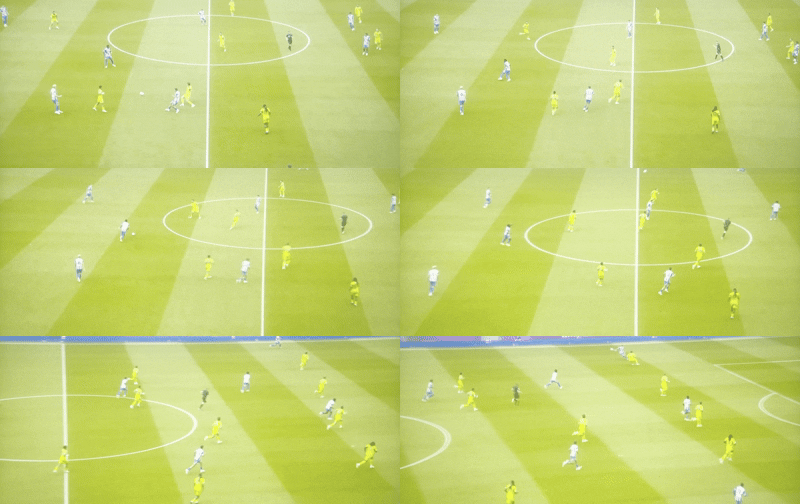
Both Mitoma and Minteh are incredibly fast from standing starts and either a) have an excellent first touch or b) can wrestle off a defender to win the ball back and they’re often kept isolated (combinations w/FBs aside) while the centre is overloaded. plus, the majority of Brighton’s [positionally deep] squad is excellent at switching play.
So it just works. It’s a good way to bait the press while [safely] progressing the ball.
Deep progression
I think Jan Paul van Hecke is one of the best defenders with the ball at his feet (in the world). Being able to carry like this just gives you another outlet through pressure, and Wieffer backtracking offers you a defensive option in case Brighton turn the ball over.

2024-2025 Big 5 European Leagues Possession Stats (Jan Paul van Hecke):
— 2nd for progressive carrying distance
— 3rd for total distance
— 16th for carries
Neat.
Subscribe
Penalties and the bee’s knees
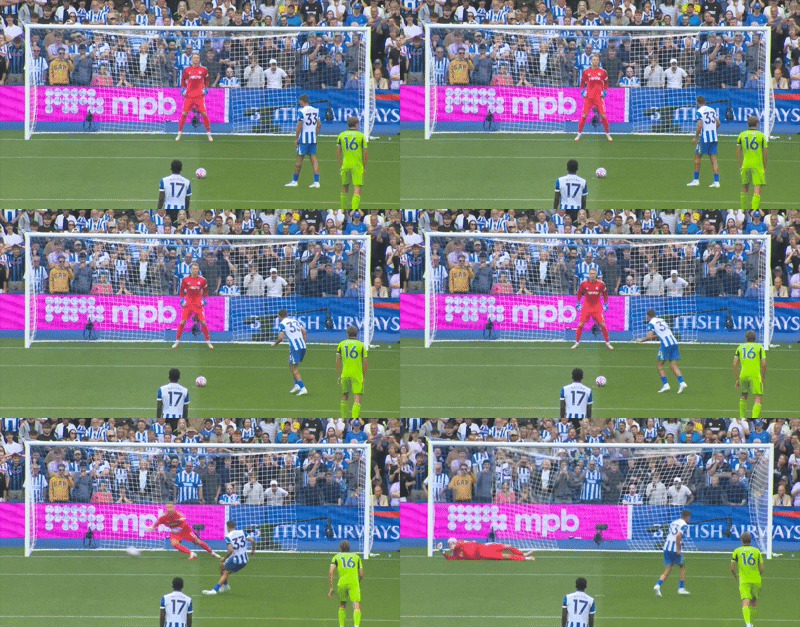
The majority of footballers jump when they shoot the ball to remove tension off their planting foot, and that’s exactly why I find Matt O’Riley’s penalty interesting. O’Riley instead keeps his knee straight but bends his foot and uses it to slide across himself, which shifts his bodyweight and the tension across himself. It’s different, but more stable when it comes to penalties.
Pressing post-subs (yikes)
I think Brighton’s subs were honestly great, because where losing Minteh + Mitoma isn’t ideal (outlet), Welbeck gives you hold-up play, Milner → work rate + experience, Kadioğlu control, etc, etc.
BUT, a lot of players got lost in the press. There was no cohesiveness there.
Take a look at this:
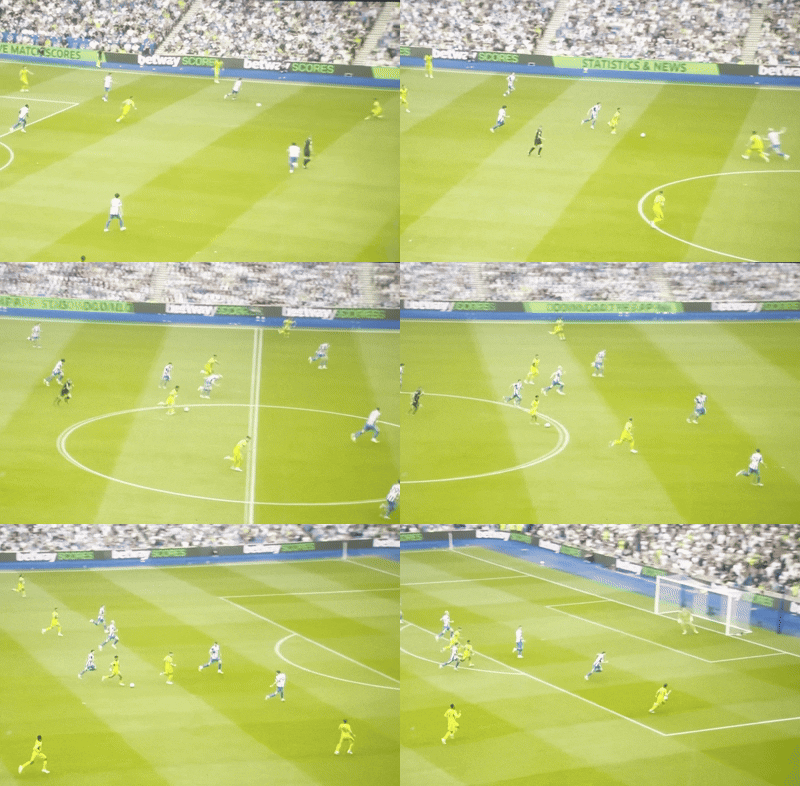
van Hecke jumps and misses. Baleba’s been subbed off (knee), so you’re left with de Cuyper — Dunk — Wieffer near the touchline, unable to make it back to goal. Realistically, it’s not their fault. The OOP shape just loses all semblance of… shape without Baleba, and is more idealistic than anything.
No Baleba → the team can’t cover big distances in short instances (I’m far too proud of this line) → players compensate → void where they were supposed to be.
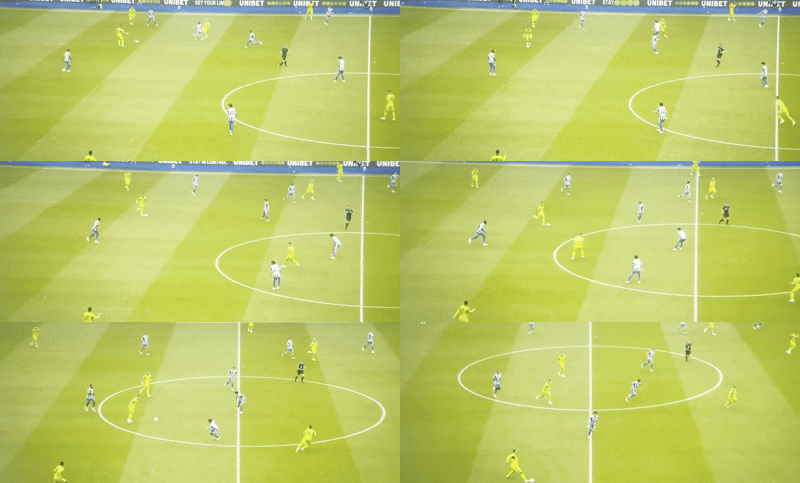
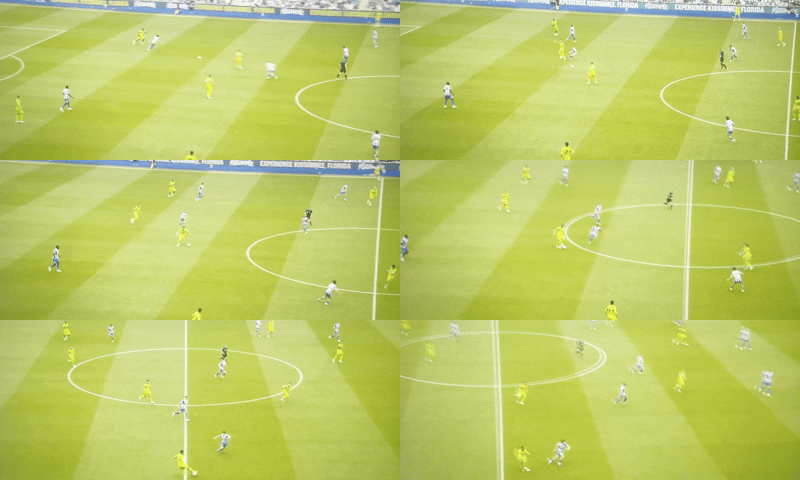
And this issue of the LW sitting in too narrow continued with Ferdi Kadioğlu:
Diego Gómez
In other news, Diego Gómez’s ball-striking is just as good as it’s ever been (very, very good):
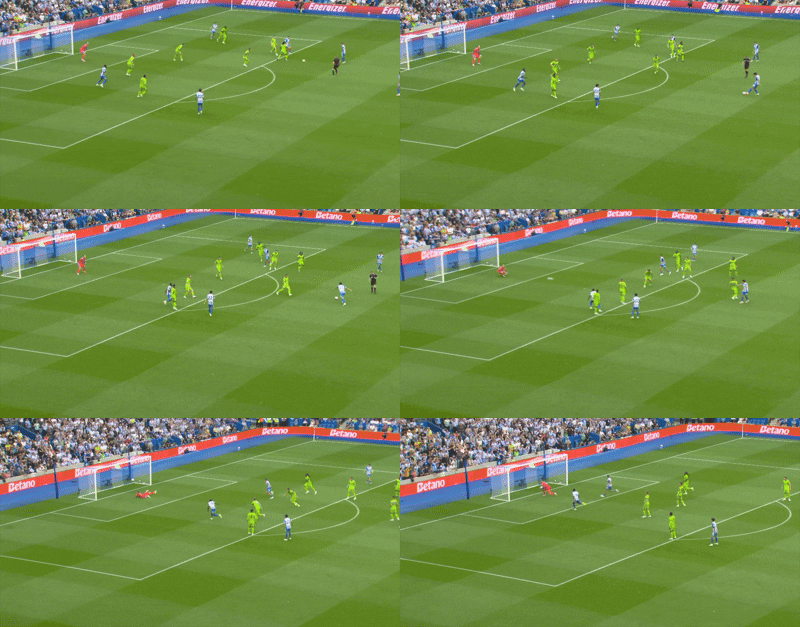
I think he’s best as an AM/winger, but can certainly put in a shift as the second pivot midfielder as long as he’s paired with (surprise, surprise) Carlos Baleba.
He had a good game offensively vs. Fulham — pressed well (though inconsistently), was energetic, wasn’t afraid to shoot + play a dangerous pass, and was lively overall.
Rodrigo Muniz
Lastly, and most annoyingly, Muniz’s goal was great:
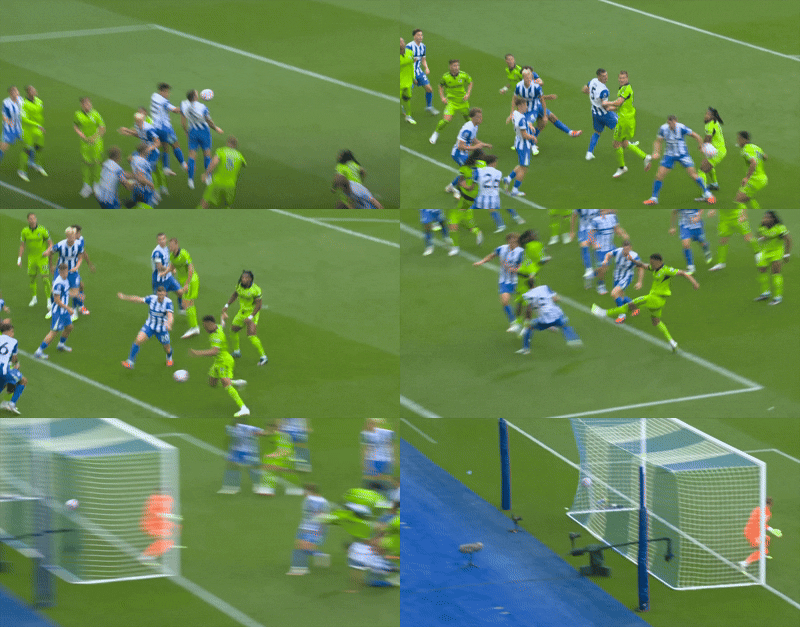
That’s a very quick finish, and a toe poke is always nice (catches opponents off-guard). I think Muniz is an excellent striker who would start for a LOT of Premier League teams, and in any other world, he’d start for Fulham. It boggles the mind as to why he doesn’t.
I’d like to conclude this piece by offering my condolences to the friends and family of the fan who passed away after the match. May he rest in peace.